Chartered Accountant Fees for Tax Filing
If you’re in the UK and wondering how much a chartered accountant fees for tax filing, you’re not alone. Many small business owners, freelancers, and self-employed professionals struggle to understand the cost versus value of hiring a qualified accountant. At its core, chartered accountant fees for tax filing reflect not just the time spent completing returns but the expertise required to ensure HMRC compliance, reduce errors, and optimise your tax position legally.
In the UK, typical fees for tax filing with a chartered accountant can range depending on the complexity of your income. For a straightforward self-assessment return, the cost may be modest, whereas a limited company director with multiple income streams, VAT obligations, or rental properties can expect higher fees. Unlike standard accountants or bookkeepers, chartered accountants carry professional designations such as ICAEW or ACCA, offering recognised qualifications and adherence to strict ethical standards.You gain the assurance that your records meet regulatory standards, minimising your exposure to fines, penalties, and time-consuming HMRC investigations.
Not every taxpayer or business requires a chartered accountant, but if your finances are multifaceted, include business transactions, property income, or overseas earnings, professional oversight becomes essential. Working with a reputable firm such as Eternity Accountants ensures not only accurate tax filing but also access to strategic advice that can optimise your business growth while staying fully compliant.
Chartered accountant fees for tax filing in the UK vary by complexity. Self-employed individuals may pay less, limited company directors more. A chartered accountant ensures HMRC compliance, mitigates penalties, and provides professional tax guidance.
What UK Tax Filing Services Does a Chartered Accountant Provide?
When it comes to tax filing in the UK, a chartered accountant offers more than just number-crunching—they bring professional oversight, regulatory knowledge, and strategic insight. Chartered accountants, whether ICAEW, ACCA, or ICAS qualified, ensure that every return they prepare is fully compliant with HMRC regulations, giving individuals and small businesses peace of mind that their taxes are handled correctly.
Their work covers both individual and business tax filings. For individuals, this may include self-assessment returns for salaried income, rental properties, or investment dividends. For businesses, it extends to corporate tax, VAT, and PAYE filings. The key difference between tax filing and tax advisory lies in scope: filing ensures that all numbers are accurate and submitted on time, whereas advisory services guide clients on tax efficiency, relief claims, and future planning.
Chartered accountants also act as a safeguard against HMRC scrutiny. They meticulously check bookkeeping records, validate expenses, and apply up-to-date tax laws to avoid mistakes that could result in fines or audits. Unlike a standard accountant or bookkeeper, they carry the professional accountability and legal expertise required to handle complex financial scenarios, such as multiple income streams, cross-border transactions, or capital gains reporting.
A UK chartered accountant ensures precise, HMRC-compliant tax filings for individuals and businesses, separates filing from advisory responsibilities, and reduces risks through professional review of all financial records.
Chartered Accountant Fees for Tax Filing — UK Price Breakdown
Understanding chartered accountant fees for tax filing in the UK can help individuals and small business owners budget accurately and choose the right services. While fees vary depending on complexity, location, and experience, a snapshot of typical UK rates offers clarity for planning purposes.
|
Service Type |
Typical UK Fee Range |
Notes / Considerations |
|
Self Assessment Tax Return |
£150 – £400 |
Includes salaried income, investment, and basic rental income reporting. More complex portfolios may increase costs. |
|
Limited Company Corporation Tax (CT600) |
£300 – £700 |
Covers preparation and submission of corporate tax returns. Complexity increases if multiple accounts or cross-border transactions are involved. |
|
VAT Returns |
£50 – £150 per return |
Monthly or quarterly VAT submissions; advisory support for reclaiming input VAT may incur extra fees. |
|
CIS Returns |
£50 – £120 per month |
For contractors and subcontractors in construction; includes monthly deductions and reporting to HMRC. |
|
Rental Income Tax |
£150 – £400 |
For landlords, includes property income, allowable expenses, and deductions. More complex portfolios may be higher. |
|
Director Tax Returns |
£200 – £500 |
Individual director self-assessment combined with company director allowances and benefits. |
Key Insight: These fees represent general UK market trends and can fluctuate based on the accountant’s qualifications (ICAEW, ACCA, ICAS), geographic location (London vs regional areas), and service complexity. Choosing a chartered accountant ensures HMRC compliance, accuracy, and professional accountability.
Chartered accountant fees for tax filing in the UK vary by service type—from self-assessment returns (£150–£400) to corporate tax and director filings (£300–£700). Complexity, location, and professional qualifications influence pricing.

Your content goes here. Edit or remove this text inline or in the module Content settings. You can also style every aspect of this content in the module Design settings and even apply custom CSS to this text in the module Advanced settings.
What Factors Affect Chartered Accountant Fees for Tax Filing?
The price of engaging a chartered accountant for UK tax preparation depends on several key variables.Understanding these factors helps individuals and small business owners budget accurately while ensuring compliance with HMRC requirements.
- Income Complexity: Multiple income streams, investments, or foreign earnings increase preparation time and analysis, leading to higher fees.
- Your business type matters. Sole traders, partnerships, and limited companies each need a distinct level of accounting skill and service.Corporate returns generally cost more than personal filings due to compliance intricacies.
- Number of Income Sources: Rental income, dividends, pensions, or side businesses each add complexity, impacting the time a chartered accountant spends preparing the return.
- VAT / CIS Registration: Businesses registered for VAT or operating under the Construction Industry Scheme (CIS) have additional reporting responsibilities, which can increase accountant fees.
- Filing Urgency & Penalties: Last-minute submissions or returns at risk of HMRC penalties often incur premium charges due to time pressure and compliance risk.
- Record Quality: Well-organised accounts and clear documentation reduce processing time and errors, helping manage costs, whereas disorganised or incomplete records may inflate fees.
Chartered accountant fees for tax filing in the UK are influenced by income complexity, business structure, number of income streams, VAT/CIS registration, filing urgency, and quality of financial records.
Fixed-Price vs. Hourly Billing: Comparing Tax Filing Payment Models
When it comes to chartered accountant fees for tax filing in the UK, the choice between a fixed fee and an hourly rate can make a significant difference in budgeting and peace of mind.
Imagine Sarah, a freelancer with straightforward income, and Tom, a small business owner with multiple revenue streams and VAT obligations. Sarah benefits from a fixed-fee arrangement, knowing exactly what she will pay for her Self Assessment tax return. This approach eliminates surprises and keeps her accounting costs predictable.
Tom, on the other hand, faces a more complex scenario. With multiple contracts, employee salaries, and VAT returns, an hourly-rate chartered accountant provides flexibility, billing only for the time spent handling the intricacies of his filings. While the total cost may vary, this approach ensures he gets expert guidance tailored to his business needs.
Key Takeaways:
- Fixed fees are ideal for standard tax filings and smaller UK businesses seeking cost certainty.
- Hourly rates work best for complex or irregular filings where time spent is unpredictable.
- Evaluating your filing complexity, income sources, and risk tolerance helps determine the optimal pricing model.
For typical UK tax filings, fixed fees offer predictable costs and minimal surprises, while hourly rates provide flexible, detailed support for complex cases.
Chartered Accountant vs Non-Chartered Accountant — Is the Fee Worth It?
When deciding whether to hire a chartered accountant for tax filing, UK small business owners often weigh the higher fee against potential value and risk reduction. The following table illustrates key differences:
|
Feature |
Chartered Accountant (ICAEW/ACCA/ICAS) |
Non-Chartered Accountant / Bookkeeper |
|
Fee |
Higher, reflects professional qualifications and compliance expertise |
Lower, may charge per hour or fixed task |
|
Error & Penalty Risk |
Minimal – regulated, trained to handle HMRC requirements accurately |
Higher – may overlook deductions, miscalculate liabilities |
|
HMRC Enquiry Handling |
Full support – can liaise with HMRC directly and represent clients |
Limited – may need external expert support |
|
Strategic Tax Planning |
Provides actionable advice to reduce liabilities and optimise returns |
Typically reactive, focuses on filing only |
|
Complexity Handling |
Can manage multiple income streams, VAT, CIS, and corporation tax |
Best for simple, standard filings only |
Key Insight:
Paying a premium for a chartered accountant can be justified for UK businesses with complex income, multiple filing obligations, or those who want HMRC-compliant, risk-free tax filing. Non-chartered professionals may be cost-effective for straightforward, low-risk situations, but they often cannot provide the same level of strategic guidance or HMRC support.
Chartered accountants cost more but offer higher accuracy, HMRC representation, and strategic tax planning, while non-chartered professionals suit simple filings at a lower cost.
Real UK Tax Filing Cost Scenario (Mini Case Study)
Understanding how chartered accountant fees for tax filing impact real UK taxpayers can help small business owners make informed decisions. Here’s a practical illustration:
Scenario 1: Self-Employed Consultant
- Profile: Annual turnover £60,000, single income stream, self-assessment filing.
- With Chartered Accountant: Fees ~£250–£400. Accurate deductions, HMRC-compliant submission, and audit support included.
- Without Chartered Accountant: Fees ~£100–£180 using a non-chartered accountant or DIY software. Risk of missed allowances, potential HMRC queries, and time spent managing records.
Scenario 2: Small Limited Company Director
- Profile: Company turnover £150,000, VAT-registered, receives dividends, requires CT600 and Self-Assessment.
- With Chartered Accountant: Fees ~£800–£1,200. Complete filing support including corporation tax, VAT, payroll advisory, and strategic tax planning. Reduced HMRC exposure and full compliance assurance.
- Without Chartered Accountant: Fees ~£350–£600 using a non-chartered accountant. Increased risk of errors, potential penalties, and limited advisory support.
Key Insight:
Investing in a chartered accountant for tax filing provides peace of mind, ensures HMRC compliance, and saves both time and potential penalties, particularly for directors or multi-income streams. While non-chartered accountants may appear cheaper, the hidden costs of errors and missed optimisation often outweigh savings.
Chartered accountants charge more upfront but significantly reduce risk, improve compliance, and provide strategic tax guidance, especially for UK business owners and directors.
When Should You Pay Chartered Accountant Fees for Tax Filing?
Deciding when to invest in a chartered accountant for tax filing is critical for UK individuals and small business owners. Use this decision-focused checklist to identify the right timing:
Decision Checklist
Income Thresholds
Once your personal or business income surpasses a certain level (typically £50,000+ for individuals or £100,000+ for small companies), hiring a chartered accountant ensures accurate calculations, maximises allowable deductions, and reduces HMRC risks.
HMRC Enquiry Risk
If your tax situation is complex—multiple income streams, rental income, or dividend payments—a chartered accountant minimises exposure to HMRC enquiries, penalties, and late submission fines.
Business Growth Stage
Startups moving from sole trader to limited company, or expanding operations with VAT registration, benefit from expert guidance. Chartered accountants support strategic planning and ensure compliance during growth transitions.
Compliance Triggers
Certain events trigger mandatory compliance, such as corporation tax filing, VAT submissions, CIS deductions, or director self-assessment. Engaging a chartered accountant ensures filings meet legal deadlines and regulations.
Quick Summary:
Paying chartered accountant fees for tax filing becomes worthwhile when income grows, tax complexity rises, compliance deadlines approach, or business structures evolve. Early investment prevents costly mistakes and saves time.
Quick Answers — Chartered Accountant Fees for Tax Filing UK
How much should I budget for a chartered accountant to complete my self-assessment tax return?
Typically between £150 and £400 depending on income sources and complexity.
What is the cost for a limited company Corporation Tax return?
UK limited company filings usually range from £500 to £1,200 per year.
Do VAT-registered businesses pay more?
Yes, VAT compliance often adds £200–£500 annually.
Are director tax returns more expensive?
Generally £200–£450 depending on dividends and salary structures.
Does rental income affect fees?
Yes, reporting rental income can increase charges slightly, typically £50–£150 extra.
How does urgency affect pricing? Last-minute filings or HMRC penalty resolutions can increase fees by up to 50%.
Is a chartered accountant necessary for simple tax filings?
Not always, but they ensure accuracy and full HMRC compliance.
What sets a chartered accountant apart from an uncertified accountant?
Chartered accountants reduce error risk and provide strategic tax advice.
Are fees usually fixed or hourly?
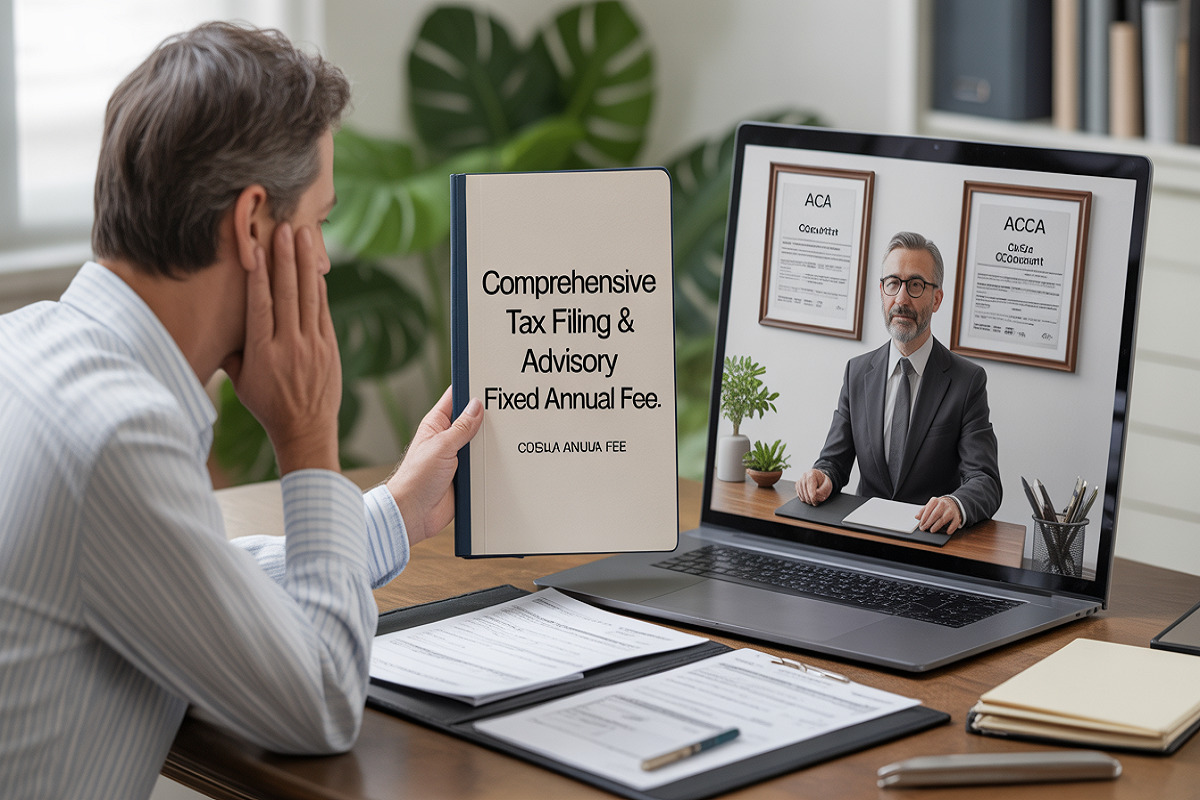
Most UK accountants offer fixed packages; hourly rates vary from £60–£150.
Do fees cover advisory services?
Some include basic guidance, but strategic tax planning is typically an additional cost.
Chartered accountant fees for tax filing in the UK vary based on filing type, complexity, and urgency, typically ranging from £150 to £1,200. Fixed-fee options are common, offering predictable costs and HMRC compliance assurance.
Voice Search FAQ — Chartered Accountant Tax Filing Costs
- How much does a chartered accountant charge for a self-assessment?
Usually £150–£400, depending on how many income sources you have. - What is the fee for a limited company tax return?
Most limited companies pay £500–£1,200 per year for corporation tax filings. - Do VAT returns increase accountant fees?
Yes, VAT-registered businesses typically pay £200–£500 more annually. - Are director filings more expensive than regular self-assessments?
Yes, usually between £200 and £450 per year. - Does having rental income change costs?
Yes, rental income reporting can increase fees slightly. - Can urgent or late filings cost more?
Absolutely; urgent submissions or penalty resolutions may add 20–50% to fees. - Are chartered accountants necessary for simple tax returns?
Optional for simple returns, but recommended for accuracy and HMRC compliance. - Are fees fixed or hourly?
Most UK accountants offer fixed packages; hourly work ranges from £60–£150. - Do fees include tax advisory?
Basic filing is included; advanced advisory or planning is usually extra. - Why choose a chartered accountant over a standard accountant?
They reduce HMRC risk, prevent errors, and provide strategic tax planning for complex situations.
Summary & Key Takeaways
Navigating chartered accountant fees for tax filing in the UK can feel complex, but the reality is straightforward when you consider the value delivered. Fees vary depending on the type of return, complexity, and urgency, from standard self-assessment returns for individuals to more detailed filings for limited companies, VAT, or CIS obligations. Chartered accountants bring certified expertise, ensuring full HMRC compliance, minimising penalties, and offering insights that can help optimise tax positions and improve financial clarity. For small businesses, freelancers, and self-employed professionals, paying for a chartered accountant is not merely a cost—it’s an investment in accuracy, peace of mind, and strategic financial guidance. By choosing qualified professionals, UK taxpayers can avoid common errors, streamline filings, and focus on business growth rather than compliance stress.
Chartered accountant fees for tax filing reflect both the service complexity and the value of risk reduction, HMRC compliance, and strategic tax advice for UK individuals and small businesses.
CTA — Secure Transparent Chartered Accountant Tax Filing Fees in the UK
Let Eternity Accountants bring clarity and confidence to your tax preparation.Our chartered accountants provide fully transparent, fixed-fee tax filing services across the UK, designed to suit individuals, landlords, freelancers, and small limited company directors. With our expert team, you gain accurate filings, HMRC compliance assurance, and practical financial guidance, all at a predictable cost. Minimise penalties, save time, and optimise your tax position with a trusted accounting partner. Contact Eternity Accountants today to get your fixed-fee quote and experience stress-free UK tax filing.