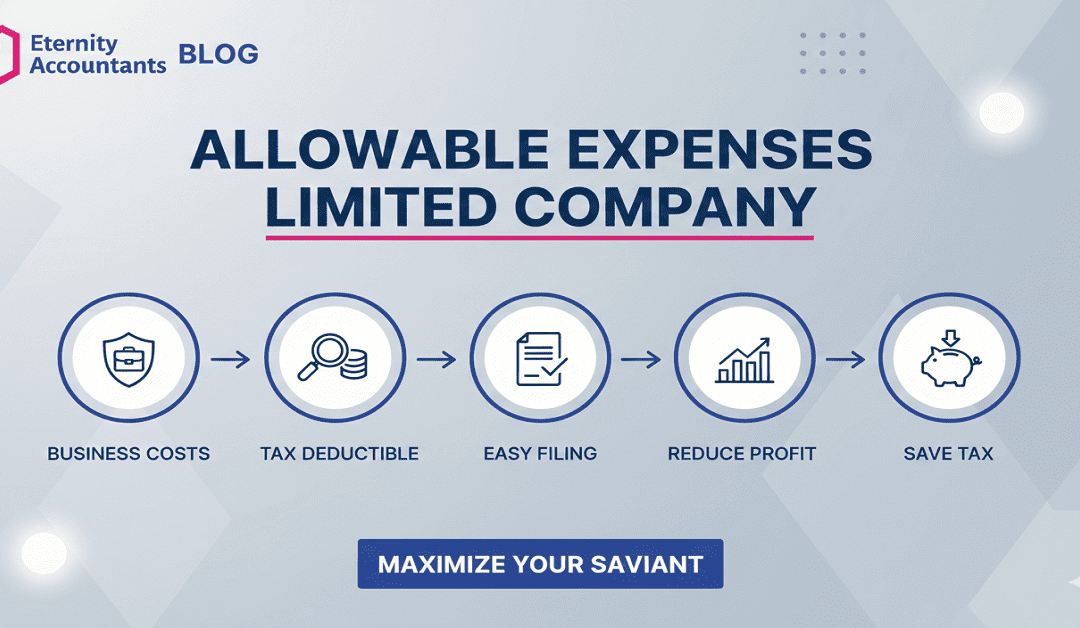
If you run a UK limited company, allowable expenses are one of the simplest legal ways to reduce corporation tax—yet they’re also one of the most misunderstood.
In short, allowable expenses for a limited company are business costs that HMRC allows you to deduct before tax, as long as they are incurred wholly and exclusively for company purposes.
For directors and small business owners, getting allowable expenses limited company rules right means lower tax bills, cleaner accounts, and fewer HMRC risks.
Getting them wrong leads to overpaying tax—or worse, compliance issues. This guide explains what really counts, what HMRC looks for, and how to claim correctly.
Understanding Allowable Expenses
What are allowable expenses?
These are expenses made wholly for business. Deducting them from your turnover lowers your taxable profit, resulting in a smaller corporation tax payment.
Common examples include professional fees, software, insurance, and business travel, provided they meet HMRC rules and are properly recorded.
Who can legally deduct business expenses in a limited company?
Both company directors and employees can claim allowable expenses limited company rules permit. Directors can claim expenses incurred while performing their role, but personal costs disguised as business spending are not allowed under HMRC compliance standards.
Do allowable expenses reduce corporation tax?
Yes. Allowable expenses limited company claims directly reduce taxable profit, which lowers the corporation tax payable. Every £1 of legitimate expense reduces profit by £1, making accurate expense tracking one of the most effective tax-efficiency tools for UK companies.
What expenses are most commonly allowed by HMRC?
HMRC commonly allows professional accountancy fees, marketing costs, office expenses, software subscriptions, insurance, and business travel. For allowable expenses limited company claims, evidence such as invoices and bank records must clearly show the business purpose.
Is a limited company allowed to claim home office expenses?
Yes, however, deductions are strictly limited to the area of your home used exclusively for work. Allowable expenses limited company rules permit either a flat-rate claim or a proportion of actual household costs. Overclaiming personal use is a frequent HMRC enquiry trigger, so calculations must be reasonable and documented.
Are director expenses treated differently from employee expenses?
They can be. While directors can claim allowable expenses limited company rules allow, HMRC applies closer scrutiny due to control over spending. Expenses must relate strictly to company duties, not personal benefit, even if paid through the company.
What costs cannot be claimed as allowable expenses by limited companies?
Personal clothing, ordinary meals, fines, and expenses with mixed personal use are generally disallowed. HMRC rejects allowable expenses limited company claims where the business purpose cannot be clearly proven or where dual-purpose costs are not correctly apportioned.
Do limited company expenses need receipts?
Yes. HMRC expects clear records for all allowable expenses limited company claims, including invoices, receipts, and bank transactions. Digital copies are acceptable, but missing evidence can result in disallowed expenses during compliance checks or enquiries.
Allowable expenses for a limited company are HMRC-approved business costs deducted before corporation tax.These expenses decrease your taxable income, must be made solely for business purposes, and must be backed by proper records. Correct claims improve cash flow; incorrect claims increase HMRC risk.
Which Costs Can a Limited Company Claim as Tax Deductions?
Allowable expenses for a limited company are genuine business costs that HMRC allows you to deduct from company income before calculating corporation tax.
In plain English, if your limited company had to spend money to operate, earn income, or stay compliant, and that cost was not personal, it is likely to qualify as an allowable expense—provided it meets HMRC rules.
HMRC’s Defining Principle
Every claim for allowable expenses in a limited company hinges on a single, strict rule: the expenditure must be made “wholly and exclusively” for business.
This means:
- The cost must be necessary for business activity
- There must be no personal benefit, or it must be clearly separated
- The business purpose must be easy to justify and evidence
If an expense has mixed use (part business, part personal), only the business portion may be claimed—anything else is disallowed.
Who can deduct allowable expenses from a limited company’s profits?
Allowable expenses limited company rules apply to:
- Company directors (including owner-directors)
- Employees incurring costs on behalf of the company
However, HMRC scrutinises director expenses more closely, because directors control company spending. This makes accurate records and clear business justification essential for compliance.
What Makes an Expense “Allowable” in Practice?
An expense is typically allowable when it:
- Supports day-to-day business operations
- Is paid by the company or reimbursed correctly
- Is recorded in company accounts with evidence
- Aligns with HMRC guidance for limited companies
Incorrect classification—especially personal costs paid through the company—is one of the most common reasons HMRC disallows allowable expenses limited company claims.
Key Facts at a Glance
For a limited company, allowable expenses are costs incurred solely for business that reduce taxable profit.HMRC permits tax deductions only when costs are incurred entirely and solely for business purposes. Directors and employees can claim them, but personal or mixed-use costs must be apportioned or excluded to remain compliant.
Who Can Legitimately Deduct Expenses in a Limited Company?
Any individual or entity incurring legitimate business costs on behalf of a limited company may claim allowable expenses—provided HMRC eligibility rules are met and the expense passes the “wholly and exclusively” test.
Below is an eligibility snapshot showing who can claim allowable expenses in a limited company, how HMRC views each role, and where errors commonly occur.
Company Directors
Eligibility: Yes — with higher HMRC scrutiny
Directors can claim allowable expenses limited company costs when they personally pay for business necessities or when the company covers them directly. HMRC expects:
- Clear business purpose
- Accurate records and receipts
- No disguised personal spending
Common director-allowed expenses include professional fees, travel for business duties, and office-related costs. Misclassifying personal expenses is a frequent HMRC trigger.
Employees
Eligibility: Yes — if incurred for work duties
Employees may claim allowable expenses limited company costs only when the expense is required to perform their role. Claims must:
- Be work-related
- Follow company expense policies
- Be reimbursed correctly
From HMRC’s perspective, employee claims are lower risk—but poor documentation can still invalidate allowable expenses limited company deductions.
Shareholder-Directors
Eligibility: Yes — with dual-role separation required
Shareholder-directors wear two HMRC hats: owner and employee. Allowable expenses limited company claims are permitted only in their director/employee capacity, not as shareholders.
Key compliance point:
- Dividends ≠ expenses
- Personal lifestyle costs ≠ allowable
Maintaining strict separation protects allowable expenses limited company claims during HMRC reviews.
Property SPVs (Buy-to-Let Companies)
Eligibility: Yes — property-specific rules apply
Property Special Purpose Vehicles (SPVs) can claim allowable expenses limited company deductions only for property-related business costs. HMRC closely monitors:
- Repairs vs capital improvements
- Loan interest restrictions
- Management and compliance costs
Allowable expenses limited company rules for SPVs differ from trading companies, making specialist knowledge essential.
Directors, employees, shareholder-directors, and property SPVs can all claim allowable expenses in a limited company. HMRC allows claims only when costs are business-only, properly recorded, and role-appropriate. Directors and SPVs face the highest scrutiny, making accurate classification essential.
How HMRC Decides If an Expense Is Allowable
HMRC approves an expense only when it is purely business-related, correctly categorised, and backed by solid evidence. If an expense delivers personal benefit, falls under capital spending, or lacks documentation, it may be reduced or rejected.
HMRC’s 4-Step Expense Evaluation Framework
Step 1: Business Purpose Validation
HMRC initially reviews the business justification for the expenditure. To qualify as allowable expenses limited company, the cost must exist only because the business operates—not because it is convenient or personally useful.
If the expense would still exist without the business, HMRC usually disallows it.
Step 2: Personal Benefit Elimination Test
Next, HMRC looks for mixed-use or private benefit.
Where business and personal use overlap, HMRC asks whether the two can be clearly separated.
- Separable use → partial allowable expenses limited company claim possible
- Inseparable use → entire claim rejected
This test is commonly applied to travel, phones, clothing, and home-related costs.
Step 3: Asset vs Day-to-Day Spend Review
HMRC then determines the nature of the expense:
- Costs that support daily trading → revenue (normally allowable)
- Costs that create long-term value → capital (relief claimed differently)
Misclassifying capital spend as allowable expenses limited company deductions is a frequent trigger for HMRC enquiries.
Step 4: Evidence Strength Check
Finally, HMRC verifies proof and consistency. An expense may be legitimate, but without evidence, it fails.
- Verifiable receipts or invoices
- A clear link to business activity
- Matching entries in accounting records
Weak or missing evidence often overrides an otherwise valid allowable expenses limited company claim.
Expert Insight (HMRC Reality Check)
HMRC does not assess expenses in isolation. Inspectors review patterns, not single claims. Regularly claiming borderline allowable expenses limited company costs without strong explanations increases enquiry risk—even if individual amounts are small.
HMRC decides whether an expense is allowable by checking business-only purpose, absence of personal benefit, correct capital or revenue treatment, and strong documentation. Passing all four tests is essential for compliant allowable expenses limited company claims.
Common Allowable Expenses for Limited Companies (HMRC-Approved)
HMRC-approved allowable expenses for a limited company typically include day-to-day operating costs that are incurred wholly and exclusively for business purposes. When correctly categorised and supported by evidence, these expenses reduce taxable profits in a compliant way.
Below is a scannable checklist table designed for fast reading, AI Overviews, and high on-page SEO performance. It reflects how HMRC commonly views allowable expenses limited company claims in practice.
HMRC-Approved Allowable Expenses Checklist (Limited Companies)
|
Category |
What’s Usually Allowable |
HMRC Compliance Notes |
|
Office & Admin |
Office rent, utilities, stationery, postage, printing, home-office proportion |
Must relate directly to business use; home costs must be apportioned fairly for allowable expenses limited company claims |
|
Professional Fees |
Accountant fees, bookkeeping, payroll services, legal advice, tax consultancy |
Fully allowable if services support company operations or statutory obligations |
|
Marketing & Advertising |
Website costs, SEO, paid ads, branding, design, business cards |
Promotional spend is normally accepted as allowable expenses limited company deductions if not personal |
|
Travel & Subsistence |
Business mileage, train fares, parking, hotels, meals while travelling |
Travel must be work-related; commuting and personal journeys are excluded |
|
Technology & Software |
Laptops, phones (business portion), cloud software, accounting tools |
Capital items may qualify for capital allowances rather than direct allowable expenses limited company deductions |
|
Business Insurance |
Professional indemnity, public liability, employer’s liability, and business protection |
Must protect the business, not personal assets, to remain allowable |
Expert Compliance Insight
HMRC focuses on consistency and proportionality. Regularly claiming similar allowable expenses limited company items with clear explanations and matching records strengthens compliance. Sudden spikes or vague descriptions increase enquiry risk, even if the expense type itself is normally accepted.
Common allowable expenses for limited companies include office costs, professional fees, marketing, business travel, software, and insurance. HMRC accepts these when they are wholly business-related, correctly categorised, and supported by evidence in company records.
Director-Specific Allowable Expenses Explained
Directors can claim allowable expenses for a limited company when costs are incurred in their role as an officeholder and meet HMRC’s “wholly and exclusively” test. The key difference is how the expense is treated for tax—especially where salary, dividends, or benefits in kind are involved.
Salary vs Dividends — Why It Matters for Expenses
When a director is paid a salary, certain costs can be reimbursed tax-free as allowable expenses for a limited company (for example, business travel or home office use). Dividends, however, are a return on shares—not payment for work—so expenses cannot be offset against dividend income. HMRC looks closely at this distinction during reviews.
Home Office Use (Director-Only View)
Directors working from home may claim a reasonable business proportion of household costs. This can be a flat-rate method or a calculated split based on time and space used. To remain compliant, the home must be used regularly for company duties—not occasionally—when claiming allowable expenses for a limited company.
Mobile Phones & Broadband
- Mobile phone: One company-provided handset per director is normally allowable, provided it is billed to the company.
- Broadband: Only the business-use proportion is allowable if the connection is also used personally. Clear apportionment protects allowable expenses for a limited company claims.
Training & CPD
Training costs are allowable when they maintain or improve existing skills required for the director’s role. Courses that prepare for a new trade or unrelated qualification are usually disallowed. HMRC treats skill relevance as a decisive factor.
Trivial Benefits (Often Overlooked)
Small perks costing £50 or less per item—such as meals, gifts, or team incentives—can be tax-free when structured correctly. Used properly, trivial benefits reduce personal tax exposure while staying within allowable expenses for a limited company rules.
Directors can claim allowable expenses for a limited company when costs are incurred for company duties and reimbursed correctly. Salary-linked expenses are usually claimable, dividend-related costs are not, and items like home office use, training, phones, and trivial benefits must meet HMRC conditions.
Travel, Mileage & Subsistence – What You Can Claim
Travel-related allowable expenses for a limited company depend on the journey type, cost method used, and whether the workplace is temporary or permanent. HMRC expects consistency and clear evidence.
Travel & Subsistence Comparison Table (Director & Company View)
|
Area |
What’s Claimable |
HMRC Conditions |
|
Mileage Allowance |
45p per mile (first 10,000 miles), 25p thereafter |
Applies when using a personal vehicle for business travel |
|
Actual Vehicle Costs |
Fuel, insurance, servicing, repairs (business portion) |
Must choose this method consistently; private use must be excluded |
|
Meals & Subsistence |
Meals during business travel or overnight stays |
Not allowed for ordinary commuting or home-to-office trips |
|
Accommodation |
Hotels or short-term stays for business trips |
Must relate to temporary business travel |
|
Temporary Workplaces |
Travel fully allowable |
Workplace expected to last under 24 months |
|
Permanent Workplaces |
Travel not allowable |
Considered ordinary commuting by HMRC |
Mileage, meals, and accommodation can be allowable expenses for a limited company when linked to genuine business travel. HMRC disallows ordinary commuting but accepts costs for temporary workplaces, overnight stays, and documented business journeys.
Home Office & Working From Home Expenses (Limited Company)
Home-working costs can qualify as allowable expenses for a limited company when the home is used regularly for business and the claim method is reasonable, consistent, and supported by evidence. HMRC focuses on apportionment accuracy and director conduct.
Step-by-Step Method Comparison (HMRC-Aligned)
Step 1: Choose Your Claim Method (Don’t Mix Casually)
There are two HMRC-accepted ways to claim allowable expenses for a limited company when working from home:
Option A — Flat Rate (Low Risk, Low Value)
- Uses HMRC’s simplified allowance
- Minimal admin, no calculations
- Best for directors with light home use
- Often underclaims but reduces enquiry risk
Option B — Actual Cost Apportionment (Higher Value, Higher Scrutiny)
- Claim a proportion of real household costs
- Based on space used × time used
- More tax-efficient but must be justified
- Common area HMRC challenges for directors
Director Risk Areas (Where Claims Go Wrong)
- Claiming a room used mainly for personal living
- Overstating business-use hours
- Switching methods frequently without reason
- Treating home office claims as “rent” (VAT risk)
These mistakes can invalidate otherwise legitimate allowable expenses for a limited company.
Evidence Checklist (What HMRC Expects)
✔ Utility bills (electricity, gas, water)
✔ Broadband bills with usage rationale
✔ Floor plan or room count explanation
✔ Written calculation method (kept on file)
Home office costs are allowable expenses for a limited company if claimed using either a flat rate or a reasonable actual-cost split. Directors must apply one method consistently and keep clear evidence to satisfy HMRC.

Capital Allowances vs Day-to-Day Expenses
Not all business costs reduce tax in the same way. Some allowable expenses for a limited company are deducted immediately, while others qualify for capital allowances, spreading or accelerating relief depending on the asset type.
Side-by-Side Comparison (Clear HMRC Logic)
| Category | Day-to-Day Expenses | Capital Allowances |
| Purpose | Running the business | Buying long-term assets |
| Tax Treatment | Deducted in full from profits | Relief via allowances |
| Timing | Immediate | Depends on allowance type |
| Examples | Rent, software, repairs | Equipment, vehicles, machinery |
| HMRC Focus | Wholly & exclusively | Asset classification |
What Qualifies as Capital?
Capital items are assets that provide long-term value, not just ongoing operations. HMRC typically treats the following as capital rather than standard allowable expenses for a limited company:
- Office equipment
- Machinery
- Vans and commercial vehicles
- High-value tools
Annual Investment Allowance (AIA) — Simplified
Most qualifying business assets can receive 100% upfront tax relief through the Annual Investment Allowance, as long as the total stays within the annual limit.This makes capital allowances one of the most powerful planning tools for limited companies when used correctly.
Equipment, Vehicles & Machinery — Practical Insight
- Equipment: Usually AIA-eligible
- Cars: Special rules apply (emissions-based)
- Machinery: Often fully claimable under AIA
Correct classification prevents HMRC rejections and protects allowable expenses for a limited company claims.
Day-to-day costs reduce profits immediately, while capital items use capital allowances like AIA. Knowing the difference ensures allowable expenses for a limited company are claimed correctly and tax relief is maximised without compliance risk.
Real UK Case Study – Saving £8,420 in Corporation Tax
The situation (before):
A London-based IT consultancy limited company, owner-managed by a single director, believed it was “claiming everything allowed.” In reality, several allowable expenses for a limited company were either missed or incorrectly treated. Home-office costs were ignored, software subscriptions were paid personally, and capital items were expensed incorrectly.
Errors identified:
- No home-office apportionment despite regular remote work
- Training and CPD treated as personal costs
- Equipment purchases claimed as day-to-day expenses instead of capital allowances
- Mileage claimed at random figures without logs
Corrections applied:
- Proper home-office calculation using actual-cost apportionment
- Reclassified equipment under Annual Investment Allowance (AIA)
- Backdated mileage using HMRC-approved rates
- Moved qualifying subscriptions and insurance into allowable expenses for a limited company
Outcome (after):
Corporation tax reduced by £8,420
HMRC-compliant records created
Lower enquiry risk and clearer cash forecasting
Director gained confidence in future expense planning
Correctly classifying and documenting allowable expenses for a limited company can unlock significant corporation tax savings without increasing HMRC risk.
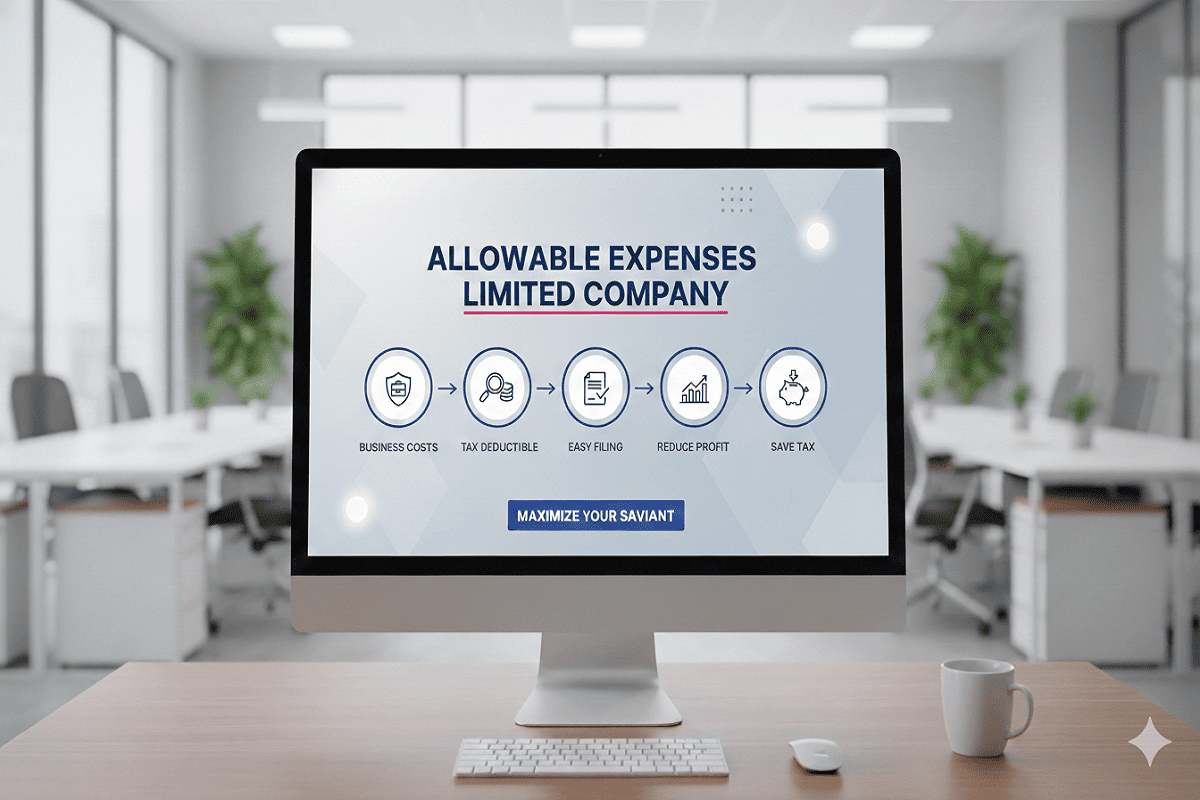
Allowable Expenses & Corporation Tax Impact
How allowable expenses for a limited company reduce tax (step-by-step):
Step 1 — Business income recorded
All company income is reported before tax.
Step 2 — Allowable expenses deducted
HMRC-approved costs are removed from revenue, reducing taxable profit.
Step 3 — Taxable profit calculated
Lower profit figure means lower corporation tax exposure.
Step 4 — Corporation tax applied
Tax is charged only on the remaining profit—not total income.
Corporation Tax Calculation Flow (Simplified)
Turnover
↓
Minus allowable expenses for a limited company
↓
Adjusted taxable profit
↓
Corporation tax due (UK rate applied)
Cash-Flow Benefit Explained
Claiming allowable expenses for a limited company does more than reduce tax—it improves real-world cash flow:
- Less tax payable at year-end
- More retained profit for reinvestment
- Improved budgeting accuracy
- Reduced need for short-term borrowing
This is why expense planning is not bookkeeping—it’s financial control.
Allowable expenses for a limited company reduce taxable profits, lower corporation tax, and improve cash flow. When expenses are correctly identified, classified, and evidenced, businesses legally keep more of their earnings while staying fully HMRC compliant.
Why Eternity Accountants Are Trusted by UK Limited Companies
HMRC-first approach
Every recommendation is aligned with current HMRC guidance, not assumptions. Allowable expenses for a limited company are assessed using evidence-led rules—wholly and exclusively, correct classification, and audit-ready records—reducing enquiry risk while maximising legitimate relief.
Fixed, transparent pricing
Clear monthly fees with no surprise add-ons. Directors know exactly what they pay and what they receive—bookkeeping, tax planning, and expense optimisation—so decisions around allowable expenses for a limited company stay cost-effective and predictable.
Director-focused advice
Guidance is tailored to owner-managed companies. From salary–dividend balance to director-specific allowable expenses for a limited company, advice is practical, scenario-based, and built around real cash-flow outcomes.
UK-based human support
Qualified UK accountants handle your account—no outsourcing. Queries on allowable expenses for a limited company are answered quickly, clearly, and with accountability.
Eternity Accountants combine HMRC-aligned expertise, fixed pricing, and director-led planning to help UK limited companies claim allowable expenses accurately and confidently.
Voice Search FAQs – Allowable Expenses Limited Company
- Allowable Expenses Explained
For a limited company, allowable expenses are business-related costs that reduce your taxable profit, provided they are incurred entirely for trade purposes.
2.Can a director claim these costs?
Yes. Directors can claim expenses incurred while performing their duties, provided the cost is legitimate, documented, and business-related.
- Are home office costs allowable for a limited company?
Yes, if calculated correctly. You can use a flat rate or apportion actual household costs based on business use. - Can a limited company claim travel and mileage?
Yes, for business journeys only. HMRC-approved mileage rates or actual costs can be used, but commuting is excluded. - Are mobile phones and broadband allowable expenses?
Costs are generally deductible for a limited company if the contract is in the company’s name and the service is used for business operations. - What expenses does HMRC usually disallow?
Personal costs, fines, client entertaining, and expenses with dual personal use are commonly rejected. - Are professional training courses tax-deductible for a limited company?
Yes, if the training maintains or improves existing skills relevant to the business—not for learning a new trade.
- What is the impact of allowable business expenses on corporation tax?
They lower taxable profits, meaning corporation tax is charged on a smaller figure.
- Do I need receipts for allowable expenses?
Yes. HMRC expects clear evidence such as receipts, invoices, and mileage logs. - Should I use an accountant for expense claims?
Using a specialist helps avoid errors, missed claims, and HMRC penalties—especially with complex allowable expenses for a limited company.
Final Summary – Allowable Expenses Made Simple
- Allowable expenses for a limited company reduce taxable profits legally
- Expenses must meet HMRC’s wholly and exclusively rule
- Directors and employees can both claim, with different rules
- Correct classification (revenue vs capital) is essential
- Good records protect against HMRC challenges
- Strategic planning improves cash flow—not just compliance
One-line takeaway:
When allowable expenses for a limited company are planned properly, you keep more profit without increasing tax risk.
CTA –
Speak to a Limited Company Tax Expert Today
Unsure if you’re claiming all allowable expenses for a limited company—or worried about HMRC mistakes?
Speak to a UK-based tax expert at Eternity Accountants for clear, compliant advice tailored to directors.
Fixed monthly pricing
HMRC-aligned guidance
Practical savings, not risky shortcuts
Book your free limited company expense review today and take control of your corporation tax.