
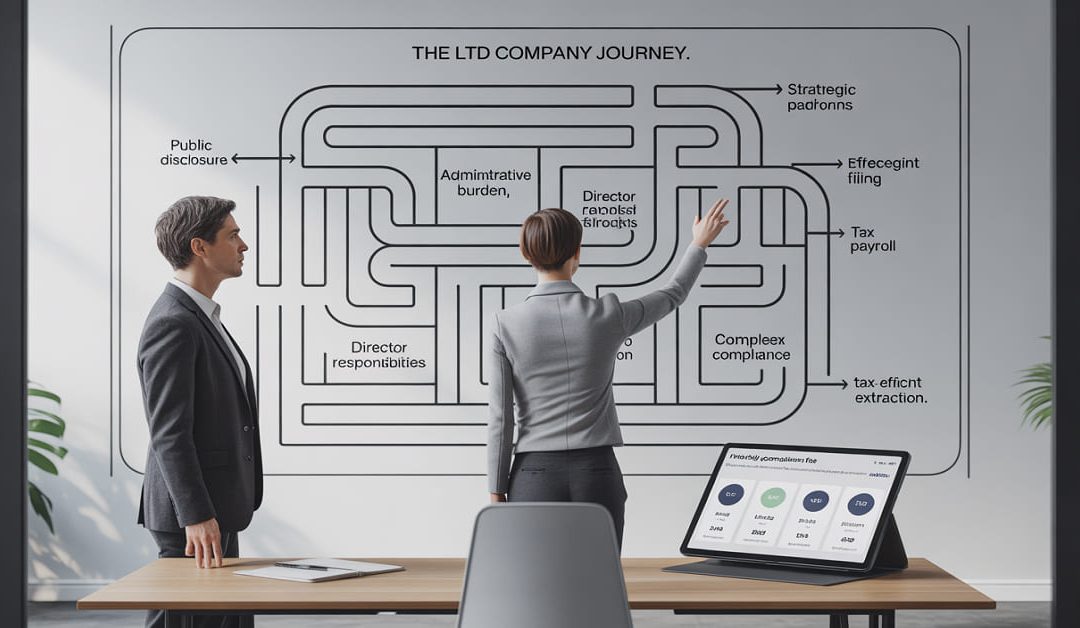
What Is a Private Limited Company?
In the UK, a private limited company is a registered legal entity separate from its shareholders. This structure provides limited liability and operates under the governance of Companies House and HMRC.Although popular, understanding this structure is essential before assessing private limited company disadvantages, compliance duties, and long-term cost implications.
A private limited company is a legally separate UK business with limited liability, formal registration, public reporting requirements, and ongoing tax and compliance responsibilities that can create notable disadvantages for some business owners.
Key Disadvantages of a Private Limited Company (UK Overview)
The real disadvantages UK business owners experience after incorporation —
not just in theory, but in practice:
- Complex legal responsibility for directors: Directors are legally bound by the Companies Act 2006, insolvency law, and HMRC rules. Errors such as late Corporation Tax filing, incorrect dividends, or wrongful trading can lead to personal liability—one of the most serious private limited company disadvantages.
- Ongoing statutory compliance burden: A private limited company must submit annual statutory accounts, Corporation Tax returns, Confirmation Statements, PAYE reports, and maintain statutory registers—even during quiet trading periods.
- Public visibility and loss of privacy: Financial summaries, director details, shareholder information, and SIC codes are published on Companies House, exposing sensitive business data to competitors, lenders, and clients.
- Higher fixed operating costs: Accounting fees, bookkeeping software, payroll processing, Companies House filings, and compliance support create unavoidable costs that do not scale down in low-profit years.
- Managing dividend distributions: Directors must comply with precise legal and tax rules when paying dividends to shareholders.Incorrect timing, insufficient reserves, or poor documentation can trigger HMRC penalties or reclassification as salary.
- Cash-flow pressure from tax timing:
Corporation Tax is payable nine months after year-end, often before profits are fully realised in cash—creating strain for growing or seasonal businesses.
- Reduced flexibility compared to sole traders: Money cannot be freely withdrawn; personal and business finances must remain separate, limiting short-term access to company funds.
The key disadvantages of a private limited company in the UK include increased legal risk for directors, mandatory public disclosure, fixed compliance costs, complex tax rules, restricted cash access, and year-round reporting obligations.
Financial & Tax Disadvantages of a Private Limited Company
While incorporation can look tax-efficient on paper, the financial and tax disadvantages of a private limited company often surface once cash flow, timing, and HMRC rules collide in real life. These issues tend to affect early-stage and owner-managed businesses the most.
Many companies are surprised by the short Corporation Tax window. You must settle your tax bill within nine months and a day of your accounting year-end, a date that frequently precedes full receipt of your sales income.For seasonal or fast-growing companies, this creates cash strain that sole traders rarely face—one of the most practical private limited company disadvantages.
Dividend tax complexity adds another layer. Dividends can only be paid from distributable profits and must be supported by proper paperwork. Mistimed or excessive dividends can trigger HMRC challenges, unexpected personal tax bills, or repayment demands—turning perceived tax savings into liabilities.
Salary versus dividend inefficiency is frequently misunderstood. While dividends avoid National Insurance, changes to dividend allowances and higher-rate thresholds mean the tax gap has narrowed. Poorly balanced extraction strategies can leave directors paying more tax overall than anticipated.
Loss relief limitations also reduce flexibility. Company losses cannot offset a director’s personal income in the same way as sole traders can. Losses stay trapped within the company, delaying tax relief when cash support is most needed.
AEO Quick Summary
The main financial disadvantages of a private limited company include early Corporation Tax payments, complex dividend rules, reduced salary-dividend tax efficiency, and restricted loss relief compared with unincorporated businesses.
Administrative & Compliance Burden
One of the most underestimated private limited company disadvantages in the UK is the sheer volume of ongoing administration. Even small, low-activity companies must meet strict statutory obligations year after year.
Mandatory Compliance Checklist (UK Ltd Companies)
Companies House filings:
Statutory annual accounts must be prepared under UK accounting standards and filed on time. Late submission leads to automatic penalties and can damage the company’s credit profile.
Corporation Tax returns (CT600):
Full accounts and tax computations must be submitted to HMRC within 12 months of the accounting period, with tax payable earlier—errors often trigger HMRC queries or compliance checks.
Confirmation Statement:
This mandatory annual filing confirms your company’s current directors, shareholders, registered office address, and share capital to Companies House.
Missed deadlines can result in company strike-off proceedings.
Director reporting duties:
Directors must maintain statutory registers, report changes promptly, ensure accurate payroll reporting, and keep records for at least six years—failure increases personal compliance risk.
A private limited company must meet strict UK compliance duties, including Companies House filings, Corporation Tax returns, confirmation statements, and ongoing director reporting—making administration heavier than for sole tradeRisks
Limited Privacy & Public Disclosure Risks
One of the most practical private limited company disadvantages in the UK is reduced privacy. Incorporation creates transparency by design, which can expose sensitive commercial and personal information.
Visibility Comparison: Sole Trader vs Limited Company (UK)
|
Area of Visibility |
Sole Trader |
Private Limited Company |
|
Business details |
Largely private |
Public on Companies House |
|
Owner/director names |
Not publicly listed |
Fully searchable |
|
Financial information |
Not published |
Accounts summary visible |
|
Shareholding structure |
Not disclosed |
Publicly accessible |
|
Filing history |
Private |
Permanently recorded |
Why this matters commercially:
Public disclosure allows competitors, suppliers, lenders, and potential clients to assess financial strength, ownership structure, and filing history. For owner-managed businesses, this can weaken negotiation positions, invite unwanted scrutiny, and increase the reputational impact of late filings—making privacy loss a key disadvantage of a private limited company.
A private limited company must publicly disclose director details, shareholdings, and financial summaries on Companies House, reducing privacy and increasing commercial exposure compared with sole traders.
Director Responsibilities & Legal Risk Exposure
One of the most misunderstood private limited company disadvantages in the UK is the extent of personal responsibility placed on directors. While the company is a separate legal entity, UK law places direct accountability on directors for how the business is run, reported, and financed.
Under the Companies Act 2006, directors owe fiduciary duties to act in good faith, safeguard company assets, maintain accurate accounting records, and prioritise creditors when financial distress arises. Failure to meet these duties—whether through inaction, poor advice, or misunderstanding—can trigger regulatory and legal consequences.
Personal liability risk emerges in specific scenarios, including trading while insolvent, paying dividends without sufficient distributable reserves, submitting inaccurate accounts, or failing to file statutory documents on time. In these cases, limited liability protections may be overridden, exposing directors to repayment orders or disqualification.
HMRC enforcement risk is a growing concern. Late or incorrect PAYE, VAT, or Corporation Tax filings can result in penalties, interest, compliance checks, and director-focused investigations. Persistent non-compliance increases scrutiny and long-term financial exposure.
UK directors can face personal legal and financial risk if fiduciary duties are breached, including HMRC penalties, director disqualification, and personal liability for insolvent trading or unlawful dividends.
Private Limited Company vs Sole Trader — Disadvantages Compared
The private limited Company disadvantages become clearer when viewed side-by-side with sole trader limitations. This comparison highlights where incorporation adds complexity rather than value for UK small business owners.
Disadvantages Comparison Snapshot
|
Area of Impact |
Private Limited Company (Ltd) |
Sole Trader |
|
Compliance burden |
Annual accounts, Corporation Tax return, confirmation statement |
Self Assessment only |
|
Public disclosure |
Accounts and director details visible on Companies House |
Financial data remains private |
|
Ongoing costs |
Higher accounting, payroll, and filing costs |
Lower professional fees |
|
Decision flexibility |
Formal processes for dividends and remuneration |
Immediate access to profits |
|
Legal responsibility |
Directors face statutory duties and personal risk |
Simpler personal responsibility |
|
Admin time |
Structured reporting and deadlines Minimal administration |
Minimal administration |
Key takeaway: One of the biggest disadvantages of a private limited company is that compliance and transparency increase significantly compared to operating as a sole trader—often without immediate financial benefit in the early stages.
Compared to sole traders, private limited companies face higher compliance, public disclosure, and administrative costs, making them less suitable for low-complexity or early-stage businesses.

When a Private Limited Company Is NOT the Right Choice
In UK practice, many incorporations fail not because limited companies are flawed—but because they are misaligned with business reality. This section reframes the decision using a clear eligibility filter, not generic advice.
Incorporation Suitability Check (Yes / No Logic)
If you answer “Yes” to several of the following, incorporation may work against you:
- Yes — Your profits fluctuate or sit below a level where Corporation Tax planning is effective
- Yes — You rely on drawing income freely rather than through salary/dividend structuring
- Yes — You value privacy and do not want financial data visible on Companies House
- Yes — You want to minimise professional fees, filings, and regulatory oversight
- Yes — Your business carries limited commercial or legal risk
In these circumstances, the private limited company disadvantages often surface quickly—through higher running costs, reduced flexibility, and increased compliance exposure. Incorporation becomes a constraint rather than a growth tool.
A private limited company is usually unsuitable when profits are low, simplicity is critical, or compliance costs exceed commercial benefit.
Real UK Case Insights — Where Ltd Companies Backfired
The following UK-based examples show how the private limited company disadvantages materialised in real trading environments. Each case reflects a different sector where incorporation created friction rather than value.
Case Insight 1: Independent Freelancer (Creative & Tech)
A UK-based freelancer incorporated to reduce tax but overlooked IR35 exposure and income volatility. Once payroll, dividend timing, and accountancy costs were added, take-home pay fell. The limited company structure restricted flexibility without delivering meaningful tax efficiency.
Key lesson: Incorporation without stable, scalable profit can reduce net income.
Case Insight 2: Small-Scale E-commerce Operator
An online seller formed a limited company to improve credibility. Instead, VAT administration, stock valuation, and statutory filings increased workload. Public disclosure also revealed turnover data competitors could exploit. The private limited company disadvantages were operational, not tax-related.
Key lesson: Brand perception alone is not a justification for incorporation.
Case Insight 3: Individual Property Investor
A single-property landlord incorporated after hearing limited companies were “more tax efficient.” In reality, refinancing barriers, dividend extraction limits, and ongoing compliance diluted returns. For this profile, the structure added cost without improving yield.
Key lesson: Property incorporation must be strategy-led, not trend-led.
Freelancers, small sellers, and single-property landlords often face higher costs and reduced flexibility when incorporating too early.
Can the Disadvantages Be Reduced with Proper Accounting?
While many private limited company disadvantages are structural, a significant number are risk-amplified by poor accounting rather than incorporation itself. This section maps common disadvantages to accounting-led solutions, showing where impact can be reduced—and where it cannot.
Solution Mapping: Disadvantage → Accounting Control
Compliance overload → Structured filing systems
Regular compliance calendars, automated reminders, and digital filing processes significantly reduce late filings, penalties, and administrative stress. This is particularly effective for Companies House and HMRC obligations.
Unexpected tax bills → Proactive tax forecasting
Quarterly profit projections and Corporation Tax provisioning prevent cash-flow shocks. Without forecasting, one of the most costly private limited company disadvantages is reactive tax planning.
Dividend errors → Reserves-based extraction planning
Many directors face penalties from unlawful dividends. Proper accounting ensures distributions are linked to verified distributable reserves, protecting limited liability status.
HMRC scrutiny → Audit-ready records
Clear PAYE, VAT, and expense documentation lowers investigation risk. Accurate records reduce exposure even when HMRC compliance checks occur.
Director liability confusion → Advisory-led governance
Accountants who provide governance guidance—not just filings—help directors understand fiduciary duties, reducing personal risk exposure.
Critical limitation:
Proper accounting can reduce operational and financial disadvantages, but it cannot eliminate public disclosure, statutory complexity, or director accountability. These remain inherent private limited company disadvantages under UK law.
Professional accounting reduces compliance, tax, and penalty risks but cannot remove structural private limited company disadvantages like disclosure and director responsibility.
Why UK Businesses Still Choose Ltd Companies (Balanced Insight)
Despite well-documented private limited company disadvantages, incorporation remains common across the UK. This is not due to ignorance—but because the structure offers context-specific advantages when aligned with the right business model.
Contextual Benefits (Without Promotion)
Risk separation for higher-liability trades
Businesses operating with contracts, staff, or commercial risk often accept compliance burdens in exchange for legal separation between personal and business assets.
Profit scalability
When profits rise beyond basic income needs, the limited company framework allows controlled remuneration through salary, dividends, and retained earnings—something sole traders cannot replicate efficiently.
Stronger reputation in professional markets
Many business clients associate the limited company structure with a more serious and established operation.While not universal, this perception still influences procurement and contract negotiations.
Investment and growth readiness
Share structures, director roles, and retained profits make limited companies more suitable for external funding or long-term expansion strategies.
Succession and exit planning
Unlike sole traders, limited companies allow share transfers, director changes, and structured exits, supporting continuity beyond the founder.
Balanced reality:
UK businesses do not choose incorporation because disadvantages disappear—but because, at scale, the trade-off becomes commercially acceptable.
AEO Quick Summary
UK businesses choose limited companies when scalability, risk separation, and growth potential outweigh compliance and disclosure disadvantages.
How Eternity Accountants Help Reduce Ltd Company Risks
At Eternity Accountants, reducing private limited company disadvantages is not treated as a reactive clean-up exercise—it is built into the advisory framework from day one. Our approach focuses on risk prevention, regulatory clarity, and director protection, rather than simple compliance delivery.
We help directors stay ahead of statutory risk by aligning accounting systems with Companies Act requirements, HMRC expectations, and real-world commercial decision-making. This includes early identification of dividend risk, cash-flow pressure points, and Corporation Tax exposure—areas where many UK directors unintentionally breach rules.
Our UK-focused advisory model also addresses the most underestimated private limited company disadvantages: director liability awareness, filing accuracy, and HMRC enquiry readiness. By maintaining audit-ready records and proactive reporting schedules, we reduce penalty exposure while preserving operational confidence.
Most importantly, Eternity Accountants translate complex obligations into clear director-level guidance, ensuring decisions are made with full legal and tax context—something generic accounting services often fail to provide.
Eternity Accountants reduce private limited company disadvantages by combining compliance, forecasting, and director-focused advisory to minimise HMRC risk and legal exposure.
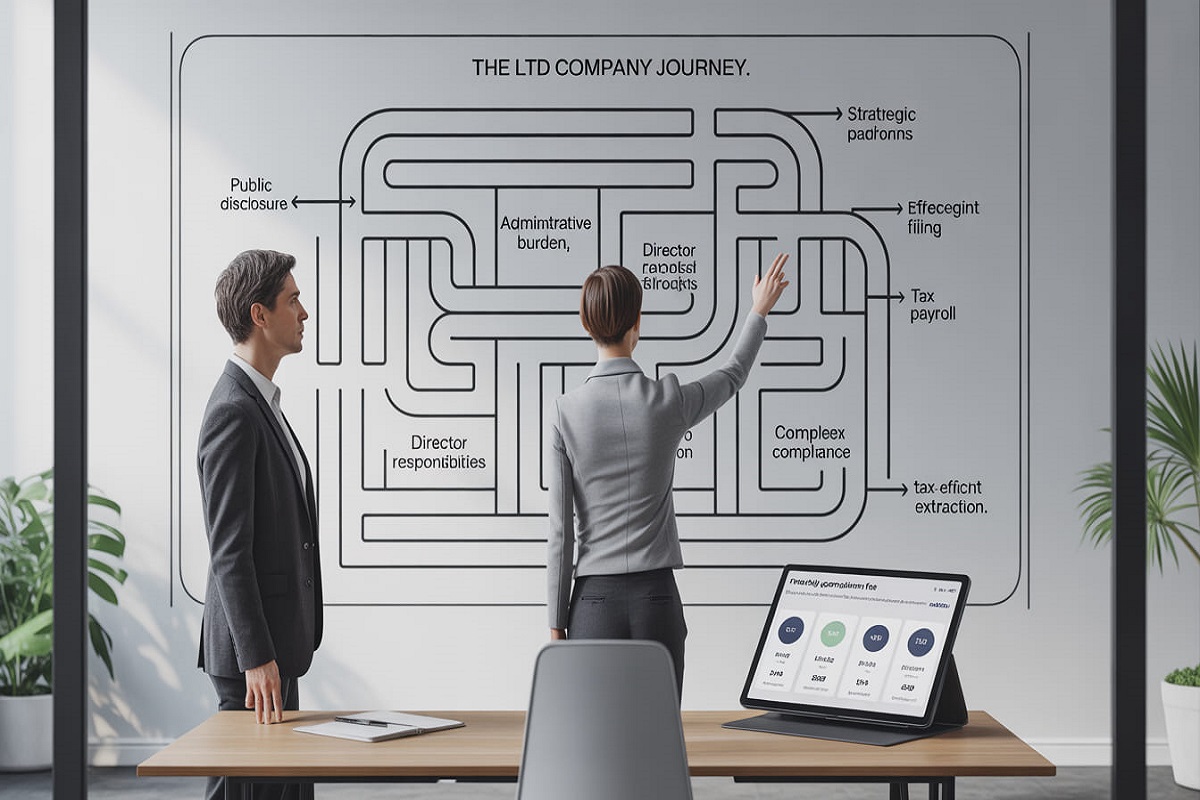
Quick Answers — Private Limited Company Disadvantages
- What is the biggest private limited company disadvantage?
Ongoing compliance and director accountability create higher administrative and legal risk than simpler business structures. - Do directors face personal risk in a Ltd company?
Yes—breaches of fiduciary duties, unlawful dividends, or insolvency errors can override limited liability. - Are Ltd companies more expensive to run?
Yes, due to accounting fees, filing obligations, and mandatory statutory reporting. - Is tax always lower in a limited company?
No—poor profit planning can make Corporation Tax and dividend tax less efficient than expected. - Does public disclosure create business risk?
Yes, as financial and director information becomes publicly accessible via Companies House.
Private limited company disadvantages centre on compliance cost, director responsibility, public disclosure, and tax complexity.
UK-Focused Voice Search FAQ
1.What disadvantages should I consider before starting a private limited company?
The main private limited company disadvantages include compliance workload, director responsibility, public disclosure, and tax complexity.
- Can I be personally liable as a company director?
Yes, UK directors can face personal liability if legal duties or HMRC rules are breached. - Is a Ltd company riskier than being a sole trader?
It is legally safer for assets, but riskier for compliance and reporting obligations. - Why do small UK businesses struggle with Ltd companies?
Many underestimate the administrative and financial discipline required to stay compliant. - Do private limited companies get more HMRC attention?
Yes, especially when VAT, PAYE, or Corporation Tax filings show inconsistencies. - Are dividends always tax efficient?
No, dividend tax becomes inefficient if profits are low or reserves are mismanaged. - What happens if Companies House filings are late?
Late filings trigger penalties and increase regulatory scrutiny. - Is accounting mandatory for Ltd companies?
Yes, statutory accounts and Corporation Tax returns are legally required. - Can a Ltd company harm cash flow?
Yes, poor tax forecasting is a common private limited company disadvantage. - Should I speak to an accountant before forming a Ltd company?
Absolutely—professional advice helps avoid structural and tax-related disadvantages from the outset.
UK voice search queries show that private limited company disadvantages relate mainly to compliance burden, tax planning errors, and director risk.
Final Verdict — Should You Avoid a Private Limited Company?
At-a-Glance UK Assessment:
- A private limited company is not suitable if you prioritise simplicity, personal privacy, and low ongoing costs over tax planning flexibility.
- It becomes high-risk when directors lack awareness of legal duties, dividend rules, or HMRC compliance timelines.
- It is often unnecessary for early-stage freelancers, side businesses, or landlords with straightforward income streams.
- It can be highly effective for stable, growth-oriented businesses—but only when supported by proactive accounting and tax oversight.
Critical insight:
Most private limited company disadvantages do not come from the structure itself, but from entering it too early or without professional direction.
Final judgement:
You should not avoid a private limited company by default—but you should avoid forming one unless the commercial and tax benefits clearly outweigh the compliance, disclosure, and director-level responsibilities.
A private limited company should only be chosen when profits, complexity, and growth plans justify the added compliance and director responsibilities.
CTA —
Get Expert Advice Before Registering Your Company
Forming a private limited company creates long-term tax, legal, and reporting obligations that cannot be undone easily. Many UK business owners discover the disadvantages only after HMRC letters, filing penalties, or dividend errors appear.
Eternity Accountants provide pre-registration advice designed to prevent those outcomes. We assess profitability, tax efficiency, director risk, and compliance workload before you commit—so your business starts on the right structure from day one.
Get a Clear Yes-or-No Recommendation from a UK Accountant
Avoid costly structural mistakes and register your company with confidence, certainty, and full compliance.
The right advice before incorporation is always cheaper than fixing it later.